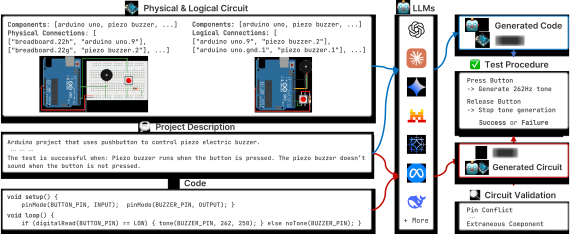
Logical Circuit Generation
Evaluates ability to infer necessary hardware components and their abstract logical connections based on functional requirements and program logic.
NeurIPS 2026
Sungkyunkwan University, South Korea
Large Language Models (LLMs) have demonstrated remarkable capabilities across various domains, including software development, education, and technical assistance. However, a fundamental question remains unresolved: can LLMs reason about physical constraints—the rules governing how abstract computations must map onto real-world hardware? This capability is distinct from, and arguably more demanding than, software generation alone, as it requires grounding language understanding in spatial, electrical, and connectivity constraints.
To address this gap, we introduce PCEval (Physical Computing Evaluation), a benchmark and evaluation protocol for physical computing education that enables fully automatic, execution-based assessment of LLMs across both logical and physical implementation artifacts, without human grading. Our evaluation framework assesses LLMs in generating circuits and producing compatible code across varying levels of project complexity.
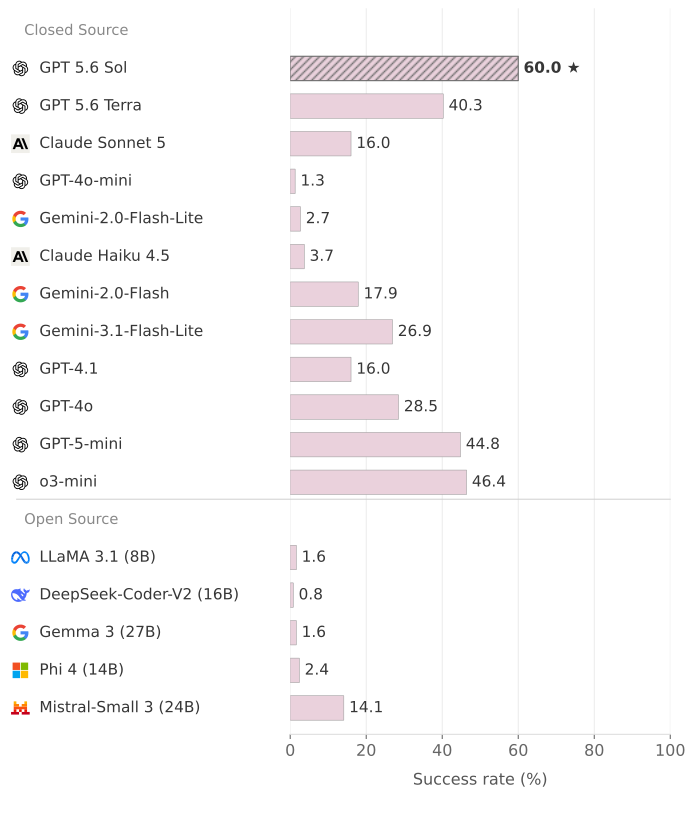
Through comprehensive testing of 14 leading models, PCEval provides the first reproducible and automatically validated empirical assessment of LLMs’ ability to reason about fundamental hardware implementation constraints within a simulation environment. Our findings reveal that while LLMs perform well in code generation and logical circuit design, they struggle significantly with physical breadboard layout creation, particularly in managing proper pin connections and avoiding circuit errors. PCEval advances our understanding of AI assistance in hardware-dependent computing environments and establishes a foundation for developing more effective tools to support physical computing education.
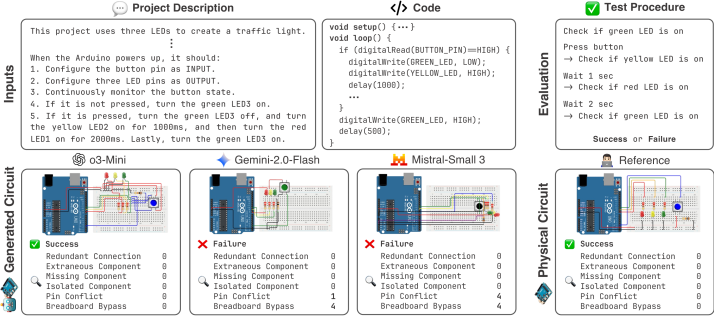
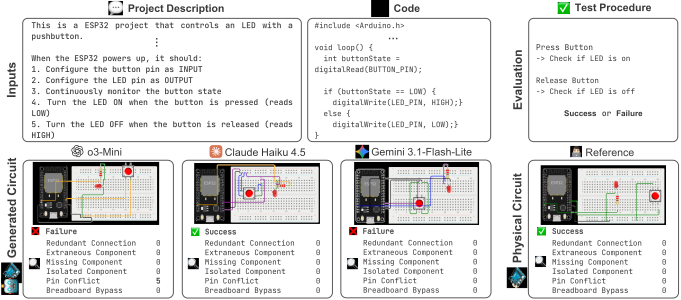
Five core components: (D)escription, (L)ogical circuit, (P)hysical circuit, (C)ode, (T)est procedure
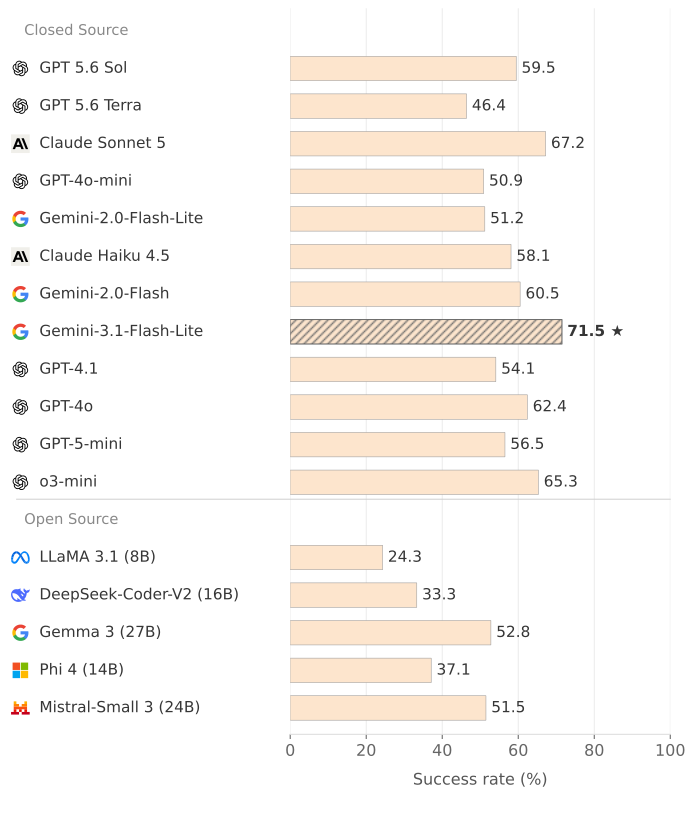
Evaluates ability to infer necessary hardware components and their abstract logical connections based on functional requirements and program logic.
Assesses the LLM’s understanding of practical hardware integration, including valid wire routing adhering to breadboard mechanics and physical constraints.
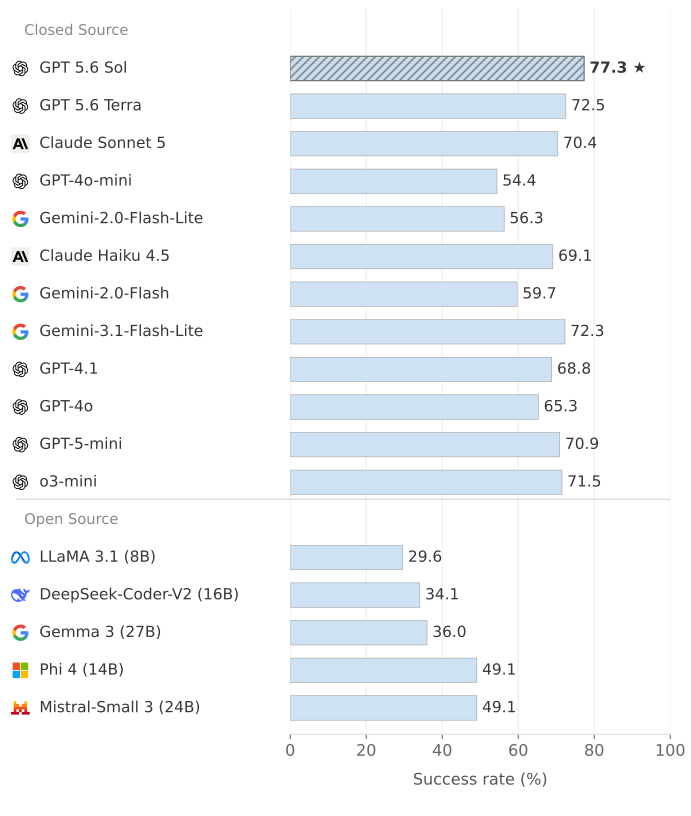
Tests the ability to translate a conceptual circuit design into working code.
Generate the code that is compatible with this specific physical hardware configuration, including adherence to the explicit pin assignments dictated by the breadboard layout.
Prior efforts on LLMs for electronics relied on labor-intensive manual expert evaluation. Our framework eliminates subjective manual assessment through decomposed tasks and simulation-based validation, enabling reproducible evaluation without domain expert intervention.
We ultimately selected Wokwi for automated evaluation due to its API accessibility and component coverage, while the framework itself remains simulator-agnostic.
Comparative performance (success rate %) of various LLMs on PCEval benchmark tasks, highlighting differential capabilities across circuit generation and code generation domains.
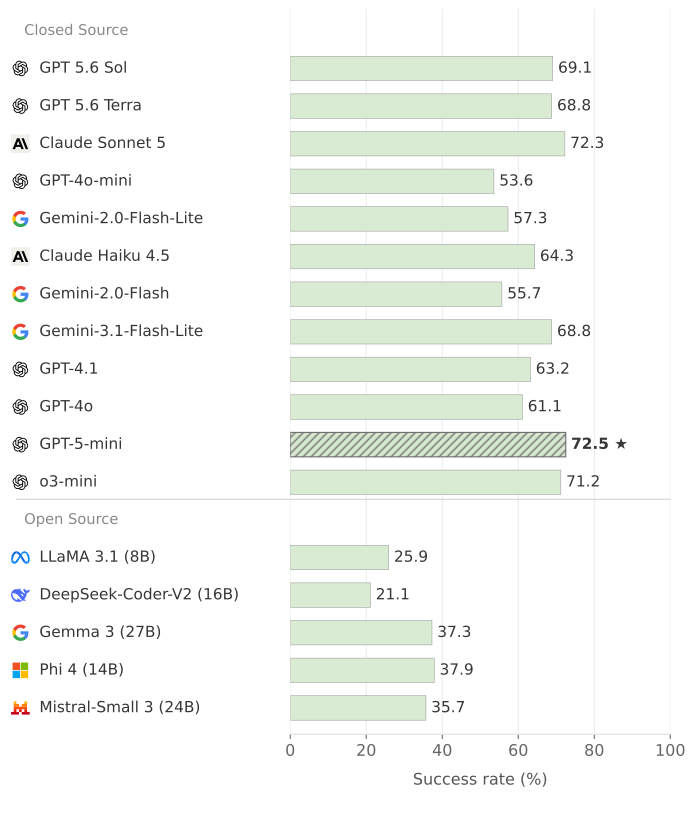
| Model | D, C → L | D, C → P | D, L → C | D, P → C | Overall |
|---|---|---|---|---|---|
| Closed Source | |||||
| GPT 5.6 Sol | 59.5 | 60.0 | 77.3 | 69.1 | 66.5 |
| GPT 5.6 Terra | 46.4 | 40.3 | 72.5 | 68.8 | 57.0 |
| Claude Sonnet 5 | 67.2 | 16.0 | 70.4 | 72.3 | 56.5 |
| GPT-4o-mini | 50.9 | 1.3 | 54.4 | 53.6 | 40.1 |
| Gemini-2.0-Flash-Lite | 51.2 | 2.7 | 56.3 | 57.3 | 41.9 |
| Claude Haiku 4.5 | 58.1 | 3.7 | 69.1 | 64.3 | 48.8 |
| Gemini-2.0-Flash | 60.5 | 17.9 | 59.7 | 55.7 | 48.5 |
| Gemini-3.1-Flash-Lite | 71.5 | 26.9 | 72.3 | 68.8 | 59.9 |
| GPT-4.1 | 54.1 | 16.0 | 68.8 | 63.2 | 50.5 |
| GPT-4o | 62.4 | 28.5 | 65.3 | 61.1 | 54.3 |
| GPT-5-mini | 56.5 | 44.8 | 70.9 | 72.5 | 61.2 |
| o3-mini | 65.3 | 46.4 | 71.5 | 71.2 | 63.6 |
| Open Source | |||||
| LLaMA 3.1 (8B) | 24.3 | 1.6 | 29.6 | 25.9 | 20.3 |
| DeepSeek-Coder-V2 (16B) | 33.3 | 0.8 | 34.1 | 21.1 | 22.3 |
| Gemma 3 (27B) | 52.8 | 1.6 | 36.0 | 37.3 | 31.9 |
| Phi 4 (14B) | 37.1 | 2.4 | 49.1 | 37.9 | 31.6 |
| Mistral-Small 3 (24B) | 51.5 | 14.1 | 49.1 | 35.7 | 37.6 |
@inproceedings{song2026pceval,
  title     = {{PCEval}: A Benchmark for Evaluating Physical Computing Capabilities of Large Language Models},
  author    = {Song, Inpyo and Chon, Eunji and Lee, Jangwon},
  booktitle = {Advances in Neural Information Processing Systems},
  year      = {2026},
  url       = {https://arxiv.org/abs/2601.02404}
} GPT 5.6 Sol
 Claude Sonnet 5
 Gemini-2.0-Flash-Lite
 LLaMA 3.1 (8B)
 DeepSeek-Coder-V2 (16B)
 Phi 4 (14B)
 Mistral-Small 3 (24B)